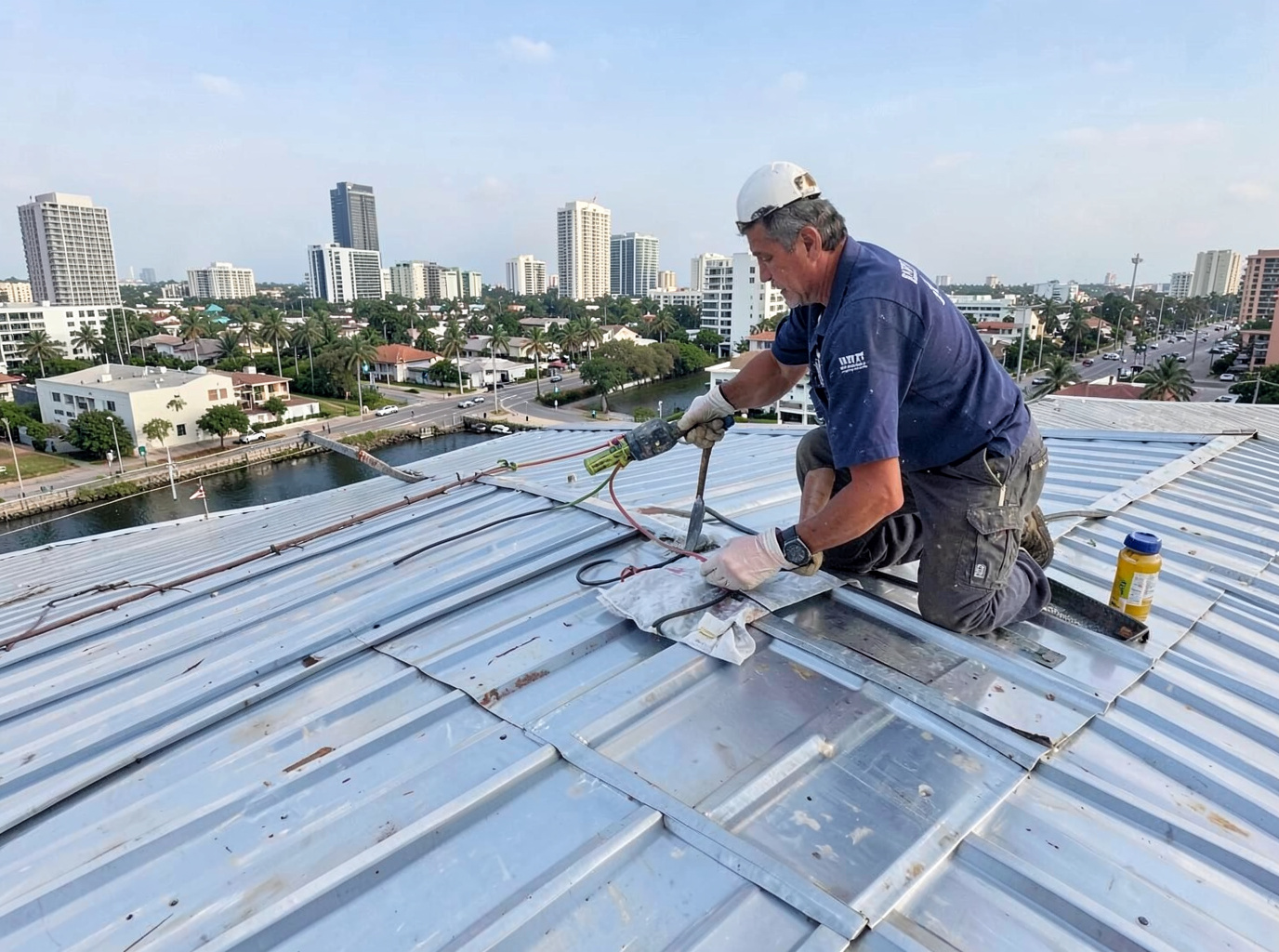
Metal roofs in Panama City must handle constant humidity, salt-laden air from the Gulf, and occasional high winds that reach neighborhoods like St. Andrews and Millville. Standing seam systems with 24-gauge steel and marine-grade coatings hold up better than thinner corrugated panels when installed over the 1960s–1980s wood-frame homes common in Downtown Panama City and Parker. Proper underlayment and sealed seams prevent moisture intrusion that accelerates deck rot in the region’s frequent summer rains.
Installation crews working near Tyndall Air Force Base or Marina Civic Center often encounter steeper pitches on older homes in Lynn Haven and Callaway that require extra clips and ridge venting to manage heat buildup. Switching from asphalt shingles to metal also means addressing existing nail pops and decking issues that appear once the old layers are removed. Local building practices favor 1.5-inch screw spacing in high-wind zones to meet Bay County uplift requirements without over-fastening that can dimple panels.
Homeowners in Panama City Beach and surrounding areas frequently request retrofits that keep the existing roof in place to limit interior disruption during the short dry windows between summer storms. Matching existing eave overhangs and gutter lines on homes in St. Andrews requires field-cutting custom trim rather than relying on standard manufacturer pieces. These details determine whether the new roof sheds water cleanly into the existing drainage or creates ice-dam-style backups during rare winter cold snaps.
Technician insight
In Panama City the thing that catches most people out with Metal Roof Installation is how fast salt air from the Gulf corrodes standard fasteners on homes within a few miles of St. Andrews State Park or Tyndall Air Force Base. Using stainless screws and heavier coatings on every job in Parker or Callaway prevents the streaking and leaks that appear within five years on cheaper installs.
Downtown Panama City Overlay
An older home in Downtown Panama City showed widespread shingle blistering and deck moisture after repeated summer storms. Inspection found intact but cupped sheathing that could support an overlay. We installed 24-gauge standing seam panels with sealed seams and added ridge venting to manage attic humidity. The roof now sheds water cleanly into existing gutters without interior disruption during the work.
Metal Roof Installation Services We Offer
✓Standing Seam Metal Roofing Installation
Concealed-fastener standing seam panels installed over new underlayment to resist wind-driven rain common along the Bay County coast.
✓Corrugated Metal Roof Replacement
Direct replacement of aging corrugated panels on utility buildings and older residences in Millville and Parker using 26- or 29-gauge galvanized stock.
✓Metal Roof Over Shingles
Overlay installation that preserves the existing deck while adding thermal breaks and ventilation for homes in Lynn Haven and Callaway.
✓Commercial Metal Roofing Systems
Low-slope metal panel systems with through-fastened or mechanically seamed details suited to retail and light-industrial buildings near Tyndall Air Force Base.
✓Metal Roof Ridge Vent Integration
Custom ridge venting added during new metal roof installation to reduce attic heat and moisture in humid subtropical conditions.
Metal Roof Installation Cost in Florida
| Service | Typical Range | What Affects It |
|---|---|---|
| Residential Standing Seam Overlay | $9–$14 per sq ft | Higher end for steep pitches or custom trim near waterfront homes |
| Full Tear-Off and New Deck Work | $3–$6 per sq ft added | Required when rotted sheathing is found in older St. Andrews homes |
| Commercial Low-Slope Panels | $8–$12 per sq ft | Varies with insulation and slope requirements |
| Ridge Vent Addition | $4–$7 per linear ft | Included on most retrofits for humidity control |
Ranges are typical for Florida and confirmed with an exact written quote before any work starts.
How it works
- 1
Site Assessment
Measure roof planes, check deck condition, and note wind exposure at the specific property in Panama City or nearby cities.
- 2
Material Selection
Choose panel profile, gauge, and coating based on proximity to salt air and the home’s pitch and existing drainage.
- 3
Deck Preparation
Repair or replace damaged sheathing, install synthetic underlayment, and add drip edge before panel delivery.
- 4
Panel Installation
Fasten panels with proper spacing, seal all penetrations, and install trim pieces to match existing gutters and eaves.
- 5
Final Walk-Through
Inspect seams, fasteners, and ventilation, then review maintenance points with the homeowner.
Pricing
Pricing depends on roof size, pitch, and whether existing shingles stay in place.